Posts

Math Challenge - SolveMe Mobile

Image
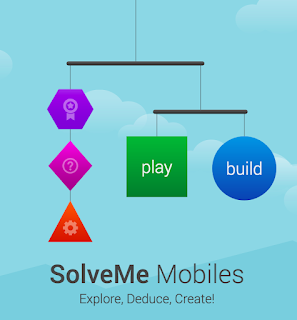
  The primary goal of this Unit is for students to develop an understanding of linear relationships. Students recognize linear relationships by the constant rate of change between two variables in a contextual situation, a table, a graph, or an equation. When you finish your work you can see how far you can go on the following math game. Math Game - Solveme Mobile

Compering and Scaling Unit New Book

Image
  Link to Comparing and Scaling Book Click here to access Essential Learnings: Understands and uses ratios, fractions, differences and percents to solve problems. Applies concepts of ratios and proportion in mathematical situations. Concepts: Write comparison statements using ratios, fractions, differences and percents. Find unit rates for given situations Work with proportional reasoning and create proportions for given problems Write equations from word problems Complete rate tables. Understand percents in forms of tax, raises, commissions and mark-ups. Understand the constant of proportionality Find scale factors between given proportions

Benchmark Fractions

Image
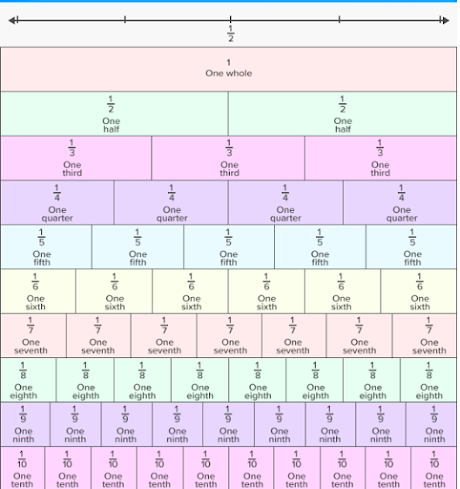
Benchmark Fraction Introduction Sheet from Mr. Cuthbert You can access this here- it lists all the benchmark fractions What is a benchmark fraction? In math, benchmark fractions can be defined as common fractions that we can measure or judge against, when measuring, comparing, or ordering other fractions. Benchmark fractions are easy to visualize and identify, and thus, help in estimating the parts. When comparing two fractions with different numerators and denominators, we can either make their denominators common or compare them to a benchmark fraction such as 1/2. Benchmark fractions are most helpful when fractions to be compared are placed on a number line against the benchmarks. Helpful Videos Created by Mr. Harrington I would just suggest that you pause throughout the videos and give yourself a chance to try the methods on your own before the video gives you the answer. Benchmark Fractions Part 1: Tenths Benchmark Fractions Part 2: Quarters and Eighths Benchmark Fractions Par...

Stretching and Shrinking Unit Assessment

  Study Guide for Stretching & Shrinking Unit Test Essential Learnings: Apply coordinate rules to stretch or shrink shapes and then plot them. Understand ways that stretching or shrinking a figure affects lengths, angle measures, perimeter, and area. Specific Skills: Draw shapes on coordinate grids and use coordinate rules to stretch (x, y), shrink and move the shapes. Determine the way that stretching and shrinking a figure affects lengths, angle measures, perimeters, and areas. Identify similar polygons and use scale factor and side length ratios to prove the similarity between polygons. Calculate the scale factor of two similar shapes and find measures of angles in similar polygons. Apply the relationship of scale factor to perimeter and area. Use the properties of similarity to find distances and heights that you can’t measure. Use specific vocabulary appropriately, use the terms we have learned and discussed in class-specific vocabulary is posted in the classrooms as well...
Creating a Winter scene or creative design.... if you are done your work early

Image
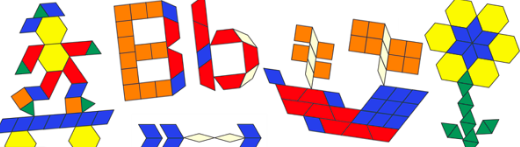
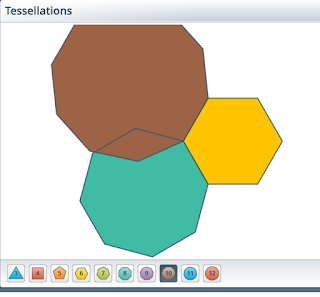
    Pattern Blocks -  Click here Pattern Block - Click here

Investigation 3 - Pattern Blocks

Image
STRETCHING AND SHRINKING INVESTIGATION 1 Click here to access the worksheet   Pattern Blocks -  Click here Pattern Block - Click here

Hour of Code is Here- 2020 Learn Today

Image
  Click here to access the Hour of Code Site Build a Retro Arcade Game Code some Disney Media Art Create a Code Quest

Inv 2.1 - Mugs

Image
  Link to the textbook pages found here. Complete the graphing on the supplied worksheet.

Inv 1.1 and 1.2 Day 2 Work

Image
  Stretching and Shrinking Find the ink to the online book here.   We will start on Page 7. Day 2  Continue to Page 8  1. TASK:  Read the scenario about the mystery club. What do you think Daphne has in mind as the Mystery Teacher? Use the picture and the information about the height of the magazine to estimate the teacher's height. Explain your reasoning. 2. APPLICATION Directions: Using your scale drawings from Wednesday, describe how the original figure and the image are alike and how they are different. Compare these features: a. How do the general shapes of the two rectangles compare? b. How do the lengths of the line segments of the two rectangles compare?  Give an example. c. How do the perimeters of the rectangles compare?  List them both below.   Help Video on Perimeter Perimeter of original rectangle: ______   Perimeter of the scaled down rectangle: _____ How do they compare? d. How do the areas of the rectangles compare? ...

Inv 1.1 an Introduction.

Image
 Hi All, Here is an introduction to the Unit. Stretching and Shrinking Overview of Ideas SIMILARITY Two figures are similar if: (1) the measures of their corresponding angles are equal and (2) the lengths of their corresponding sides increase by the same factor, called the scale factor . SCALE FACTOR The number used to multiply the lengths of a figure to stretch or shrink it into a similar image. A scale factor larger than 1 will enlarge a figure. A scale factor between 0 and 1 will reduce a figure. Preview activity: You will need: A ruler A pencil A blank sheet of paper 1. Draw a rectangle on the paper with whole number side lengths between 1-4 inches 2. Label its corners ABCD 3. Draw a second rectangle similar to the first (ABCD) with a scale factor of ½.  (reduce each side length by ½.   4. Label its corners EFGH. 5. Draw a right triangle with whole number leg lengths between 1-4 inches 6. Label its corners ABC 7. Draw a second right triangle similar to the firs...

New Unit - Stretching and Shrinking

Image
 Link here to the virtual Text Book

Study Guide - Accentuate the Negative Assessment

  Here is the Study Packet Click here to access Here are the answers to the study packet. Click here to access it. Topics to be covered on the quiz: Equivalent statements, “subtracting a positive is like …” example: Write an equation that is equivalent to - 4 - 10 Insert  >, <, or = to make the statement true.  example: 0.5 -½  Write numbers from least to greatest. Fact families - solving for n, for example, give the fact families for the following equation n - - 11 = 20 Use a number line to show an equation or distance of change between two values. Examples on page 14 and pages 36 & 37 Solve addition and subtraction integer problems. Solve multiplication and division integer problems. Graph inequalities on number lines. Write inequalities from provided number lines. Solve order of operation problems.

Skills #7

 Click here to access Skills #7 Answer Key to Skills #7

Multiplying Integers.

Image
Check-in Complete the following problem set Find the Answers here Video on Multiplying and Dividing Integers   Learn and play the Product Complete the game Online Link here

Skills #6

 Click Here to Access Skills #6 Answers to Skills #6 found here

Study Guide for Part I of ATN Test

  Accentuate the Negative- Check-in Investigation 1 Essential learnings: Demonstrate an understanding of arithmetic operations for integers (positive and negative numbers). Content covered: 1. Locate numbers on a number line and their opposites Examples: Investigation 1.2 A 1 and 2 2. Graphing inequalities on a number line Examples: Inv. 1.2 ACE 23 - 34 3. Solve word problems with addition and subtraction Examples: Example #47 p. 23 & 56 p. 25 4. Addition and Subtraction of integers Examples: Inv 1.3 ACE p. 16 Number sentence -  Starting Value + Change in value (+ or -) = Ending value 5. Find the missing value in a word problem when 2 of the 3 values are given Examples: p.19 1.4 part D&E  p.  #49-52 Helpful Study Guides for the Test: 1. Complete the Check-in, partner quiz - you have the hard copy of this.  If not access it here to print off. Answer Key Found here- Check your work. 2. Math Reflection #2 - you have the hard copy of this.  ...

Skills #5

 Click here to access Skills #5 Answer Key Found Here

Skills Review #1-4

Image
 Skills Review Sheet #1-4 Found here This needs to be completed by next Wednesday Answers can be found here First Skils Test will be Thursday, Oct 15th (Cohort 1) and Friday, Oct 16th (Cohort 2) of next week. Some Helpful Videos on Skills: Percent of a Number Dividing Fractions A Number is what Percent of another Number A Number is What Percent of a Whole?

Inv 2.2 Subtracting of intergers.

Image
Answers to page 45 ACE #18-29 - Answers Found here. Subtraction of integer strategies: Students may already see that you can change a subtraction expression to addition by adding the opposite of the second number. Some may realize that when you are subtracting, you will get a positive answer if the number you start with is greater than the number you subtract. For example,  17   +   −   15   +   ,  17   +   −   1   −   , and  15   −   −   21   −   all give positive results. You will get a negative answer if the number you start with is less than the number you subtract. For example,  13   +   −   1   +   5   ,  1   −   −   1   +   5   , and  1   −   5   −   1   −   3   all give negative results. To find the value of the answer, you find the difference of the numbers. Some students will thin...